
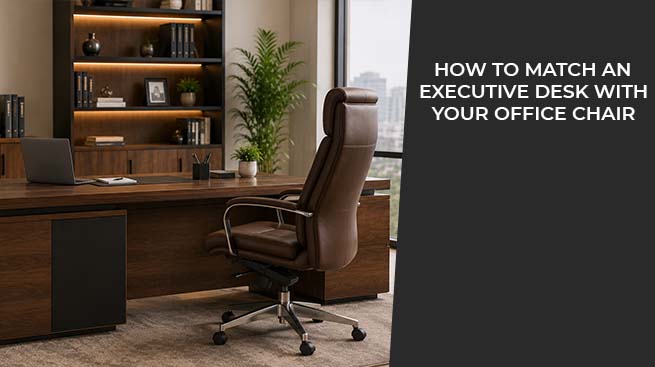
An executive office is more than just a place to check emails and documents. It reflects your professional image, personal brand, and leadership style. In the heart of this place there should be two elements of the office that have their special significance: the executive desk and the office chair. Although they have different purposes, they are attached to each other and create an integral part of your office design.
Making your desk and chair complement each other takes more than just placing any pieces of furniture in your room without thinking about its harmony and beauty. The key here is to use all possible means to combine furniture pieces correctly: scales, finishes, ergonomic solutions and aesthetics. No matter whether you furnish a corner office in a skyscraper or a home study, you can find a great variety of options at Furniture Castle Executive Desks and Office Chairs stores. This article is to guide you on how to match your desk with your chair properly.
Structure of the Pairing: Executive Desks vs. Office Chairs
Before proceeding with the discussion on how to match the two furniture pieces, it is essential to familiarise oneself with the unique structural elements of executive desks and luxury office chairs.
- The Executive Desk

Oxford Executive Desk 2.4m - Golden Oak & Grey
As a rule, it is a large and deep desk, different from the usual task desks; it creates dominance in the room. It includes big surface spaces, built-in support, modesty panels, and luxurious finishes, all of which require seating to balance.
- The Executive Office Chair

Toorak Mid-Back Executive Chair – PU Leather Finish
As opposed to light visitor and drafting chairs, executive chairs have high backrests, comfortable cushions, large sizes, and advanced ergonomic mechanisms. Being positioned in front of or behind the desk, the chair interacts with it permanently in height, armrests and upholstery.
If you want to get a better understanding of how to choose a proper arrangement, check out our recommendations in the Executive Office Desk Buying Guide.
Matching by Material and Finish: Wood, Leather, and Metal Harmony
One of the best methods of complementing your desk with your chair is via proper material selection. You do not need the perfect match, but the materials need to speak to each other.
- Timber on timber or leather on timber: For an executive desk made from natural walnut or oak, the use of a leather executive chair with a tan, brown or black PU/leather creates a classic and elegant boardroom look. The wood balances the texture of the leather.
- Modern and Glossy Material, Aluminium Bases: If you have a contemporary office setup where you are using glossy white desks or aluminium-framed desks, the best fit for an ergonomic mesh chair would be one with polished aluminium bases or grey frames. For more information on the best ergonomic chairs suited for the modern office, read our guide to the Best Ergonomic Office Chairs in Australia.
- No Clashing Textures: Do not try matching your ultra-rustic, raw-edge reclaimed timber desk with a hypermodern neon gaming chair.
Scale, Proportion, and Spatial Balance
It is in proportion that most office spaces fail to live up to expectations. A huge and double-based executive desk will instantly consume a small and slim task chair, turning it into an afterthought. In contrast, an enormous and high-backed executive chair may totally consume a minimalist executive desk.
The Golden Rule of Visual Weight
Go for heavy and powerful executive desks to match high-back executive chairs, which have plenty of padding and sturdy construction. If you want light and leggy executive desks (such as open-frame glass or slender wood desks), then mid-back executive chairs and streamlined ergonomic mesh chairs will do the trick to avoid visual blockage under the desk.
Height and Clearance Proportions
Make sure the adjustable armrests can slide under the desk without hitting the underside frame/panel or the keyboard tray.
Color Theory and Palette Coordination for Professional Spaces
It is the colour harmony that determines whether your office becomes a mess or becomes pleasant. In terms of choosing a colour when matching your desk and chair, you need to have a clear plan:
- Monochromatic Style: It consists of using an executive desk in black together with a high-back chair in black leather and all matte black accessories. Such consistent use of black tones will make it possible not to distract yourself with other colours, thus creating an image of total power.
- Contrasting Style: Combine an executive desk in walnut or dark oak with a beige or tan leather chair (in particular, a caramel executive one). In such a way, you will stress the beauty of both items. Through combining deep wood tones with leather ones, you will create a contrasting effect, making your professional office seem cosy.
- The Neutral Anchor: If your desk has a lavish finish or pattern, select your chair in a neutral colour such as charcoal, light grey, or black, letting your desk carry on making its mark in the room. This will help you make sure that your accent pieces really make their impact without overpowering the room.
Pairing Styles: Traditional, Modern Minimalist, and Industrial
Different types of spaces need different desk and chair combinations:
|
Office Interior Style |
Recommended Executive Desk |
Ideal Office Chair Pairing |
|
Traditional & Executive |
Solid wood, walnut, carved modesty panels. |
High-back tufted leather executive chair with timber-accented armrests. |
|
Modern Minimalist |
Clean lines, white 2Pac finish, or smooth matte laminate surfaces. |
Slim-profile mid-back executive chair or sleek grey mesh ergonomic chair. |
|
Industrial / Contemporary |
Mixed media timber top combined with black or charcoal powder-coated metal legs. |
Black frame mesh task chair or tan PU leather chair with a dark metal base. |
Rules for Proper Fitting and Clearances
Apart from aesthetics, another important factor is how the chair and desk work together to provide proper support and a smooth workflow.
- Clearance for the knees and legs: There must be sufficient space between the floor and the desk in order to allow the chair's armrests (placed at the best ergonomic height) to pass under the desk. The importance of having enough clearance lies in the fact that otherwise the chair would keep hitting the desk, causing damage to the furniture and your body posture.
- Clearance for Swivel and Rotation Movement: Executive desks often have returns or mobile pedestals, so make sure there is enough space under for your chair to rotate 360° and roll freely without hitting wires, rugs, or desk legs. The absence of any obstructions is not only good for your physical movement but also extends the life of your chair wheels; for more information, see our guide on cleaning an office chair.
Creating a Cohesive Workspace with Furniture Castle
Finding an executive desk to match your office chair is definitely one of the best examples of where style meets functionality. You get to carefully select materials, proportions, ergonomics, and decor, thus creating a workspace that will be not only impressive but also conducive to your productivity and comfort. Putting in the effort to guarantee proper coordination of those two key pieces will guarantee you an inspiring and comfortable work environment for years to come.
Find out the entire range of professional furniture offered by Furniture Castle, including executive desks and comfortable office chairs, and create your own unique work environment based on your personal preferences. Such a thoughtful investment in quality will provide you with a great base for your successful career.
Frequently Asked Questions (FAQs)
-
Do I need to match the wood tone of my executive desk exactly with my office chair?
No. Trying to match exact wood grains from different manufacturing lots can sometimes create slight variations that look accidental. Instead, choose complementary tones; for example, pair a dark walnut executive desk with a black leather chair or a natural oak desk with a tan leather chair.
-
What is the difference between an ordinary task chair and an executive office chair?
In comparison with ordinary task chairs, executive office chairs are generally bigger and have higher backrests. Moreover, these chairs have more generous padding and luxurious upholstery. Executive office chairs are made of high quality.
-
Is it possible to use an ergonomic mesh chair with the traditional executive desk?
Yes. Combining high-quality ergonomic mesh chairs with a traditional timber desk allows for getting a transitional style. This approach will guarantee all-day ergonomic support while looking professional. -
How do I know if my office chair armrests will fit under my executive desk?
Before making a purchase, measure the distance between the floor and the bottom surface of the desk. Usually, an executive desk leaves 650 to 700 mm of knee space.


Leave a comment
This site is protected by hCaptcha and the hCaptcha Privacy Policy and Terms of Service apply.